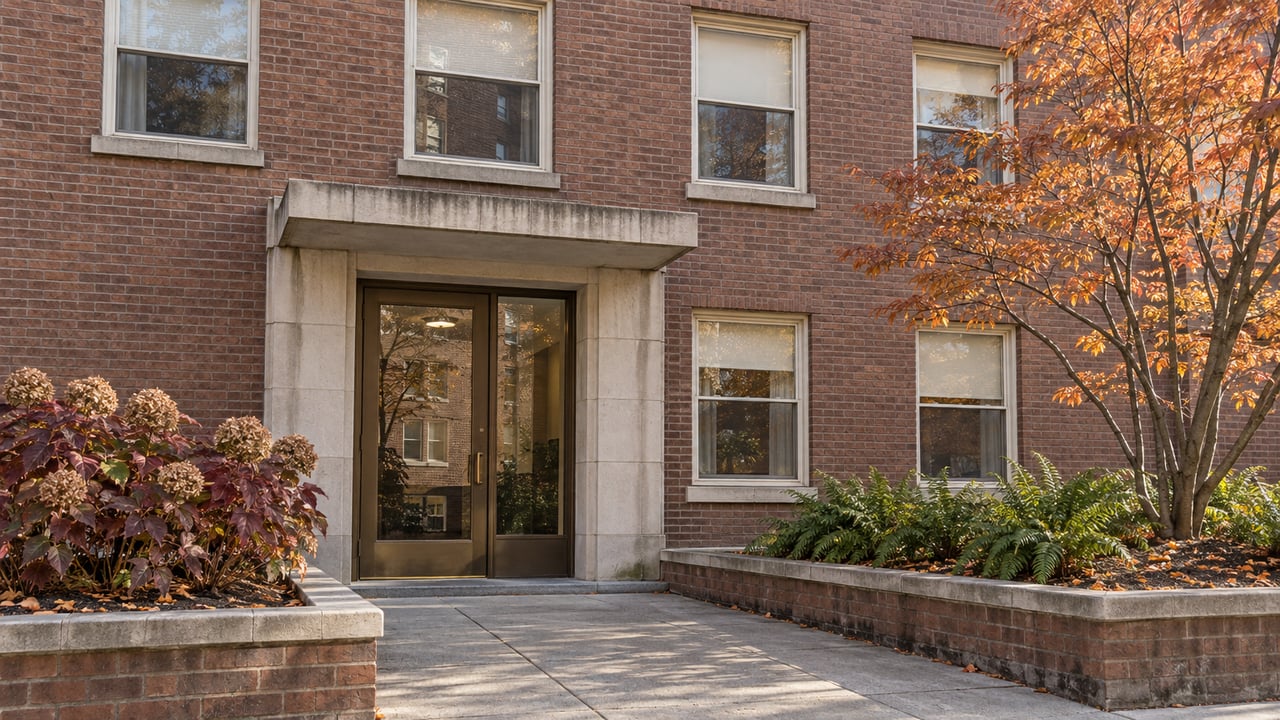
When a shareholder sells an apartment at Queensview, the 14-building co-op in western Queens, the co-op keeps 20 to 25 percent of the selling price as a transfer fee, depending on when the seller bought. Citywide, flip taxes generally run one to three percent. Queensview's treasurer, Alicia Fernandez, told Skylight that the fee brings in $2.3 million to $2.9 million a year. That reserve paid for most of the complex's energy upgrades, and no shareholder was assessed for them.
Glen Oaks Village has 2,904 garden apartments in northeastern Queens and is subject to the same emissions law. Its president has described a very different outcome, with cost estimates reaching about $35,000 per shareholder.
Every large Queens co-op faces the same carbon deadline. What differs is who pays for it, and the building's own finances largely settle that before a buyer ever sees the listing.
The 2030 cap is where the money question starts
Local Law 97 applies to most buildings over 25,000 square feet. It sets a goal of cutting carbon emissions 40 percent by 2030, and the limits tighten in 2030. Under the Department of Buildings' current rules, a building on the Article 320 compliance path that goes over its limit owes $268 per metric ton of excess emissions per year.
The first compliance period went well. On September 25, 2026, the Mayor's Office reported that 95 percent of large privately owned buildings met their emissions limits. The 2030 caps are much harder. Using benchmarking data, Urban Green Council estimates that about 57 percent of properties currently emit more than their 2030 cap allows. Joe Chavez, director of sustainable buildings at the Mayor's Office of Climate & Environmental Justice, told New York Focus that the city estimates 1,300 to 1,400 co-op and condo developments are projected to be over their limits in 2030.
Whether a building spends on upgrades or pays penalties, the money has to come from somewhere, and in practice the options come down to three.
Three ways the bill gets paid
- Current shareholders, through a special assessment or higher monthly maintenance.
- Future sellers, through a flip tax that builds reserves each time an apartment changes hands.
- The property tax bill, through the J-51 R abatement, which repays qualifying capital work over time.
The third option became more generous this year. New York State renewed J-51 for ten years in its June budget, and the City Council passed the local update on September 24, 2026, covering upgrades made to comply with Local Law 97. As New York Focus described the revamped program, buildings can recover 100 percent of "reasonable costs," up from 70 percent, by abating up to half of their annual property tax bill over several years. Housing Preservation and Development decides what counts as reasonable.
The abatement pays the money back after the work is done. Jane Menton, legislative director of Co-op and Condos United of New York, explained the catch to New York Focus: "Buildings still have to raise the capital for these projects upfront, either through loans and assessments, and without certainty as to what the certified reasonable cost will be as a percentage of the total cost of the project."
That means the first two options still decide who pays first. A building with a deep reserve can fund the work and then recover part of it through J-51. A building without one has to borrow or ask current shareholders for the money.
Two Queens complexes, two funding structures
| Queensview | Glen Oaks Village | |
|---|---|---|
| Size | 14 buildings, 700+ apartments, 10 acres | 134 buildings, 2,904 apartments |
| Full electrification estimate | About $60 million, judged infeasible | $50M to $70M in February 2026; about $100M in September 2026 |
| Approach | Efficiency upgrades to existing systems | Detailed estimates not released pending board approval |
| Main funding source | Reserve fed by a 20% to 25% flip tax | Over $16 million in investments; mortgage paid off in 2024 |
| Shareholder assessment | None for these projects | About $35,000 per shareholder, per the president's estimate |
Queensview ruled out full electrification partly because the street lacked the electrical capacity, and expanding it would have meant Con Edison work billed entirely to shareholders. Instead, the co-op insulated its steam pipes and boilers, replaced roof insulation during scheduled repairs, and added a building management system and submetering. It also required Energy Star air conditioners and LED lighting. Apart from the roof and submetering work, those projects cost about $400,000. State and utility rebates covered part of the cost, including $120,000 from NYSERDA for the building management system and $64,000 from Con Edison for boiler jackets. The co-op also qualified for nearly $3 million in J-51 tax breaks over nine years. Its projected 2030 penalty had once been about $450,000. Using 2024 data, the co-op recalculated it at $153,534.
According to Skylight, Queensview raises maintenance every few years rather than every year. Fernandez said the board has "contemplated levying a capital assessment to raise funds, but this would be a hardship for many of our shareholders."
At Glen Oaks Village, the public figures come from the co-op's president. City & State reported in February 2026 that he estimated $50 million to $70 million for required upgrades and said the co-op might face fines starting around $1 million a year. In September, he gave New York Focus an estimate of about $100 million, which would mean a special assessment of around $35,000 per shareholder. The outlet noted that his projections have varied and that the co-op's 2025 financial statement shows the mortgage was paid off in 2024 and more than $16 million held in investments. These are estimates, not budgets the board has approved.
The two complexes have similar origins as middle-income Queens housing. A buyer at Queensview pays a steep fee on the way out, and that fee helps keep current owners from being assessed. A buyer at a building without that kind of reserve may face less on resale but more uncertainty while living there.
The maintenance line is rising for other reasons too
Carbon compliance comes on top of costs that were already climbing. Co-op property taxes are paid through monthly maintenance. Habitat's report on the city's tentative 2026/27 assessment roll put the citywide average co-op tax at $9,944, up 4.1 percent. The reason is structural. City assessors value co-ops and condos against comparable rental apartments, so a strong rental market raises a building's taxes even when its apartments haven't gained much value. "If people wonder why they're paying 15% more in taxes when their apartment isn't worth 15% more than it was four years ago, it's because the rental market is doing better," Rosenberg & Estis attorney Benjamin Williams told Habitat.
Labor costs are rising as well. According to CooperatorNews, the tentative 32BJ agreement reached in April 2026 gives residential building workers $4.50 an hour in raises by the end of the four-year contract.
Taxes and wages raise costs at every building at roughly the same pace. The carbon bill is where buildings differ, which makes it the part of a co-op's finances most worth comparing.
What a buyer can check before making an offer
A few official records show where a building stands, and one of them is updated this month.
- The LL33 energy grade. Covered buildings receive an annual efficiency label, and it must be posted near each public entrance within 30 days after October 1. Grades A through D are based on score. F means required benchmarking data is missing, and N means the building is exempt. Labels also appear in each covered building's property profile on the DOB NOW Public Portal.
- LL84 benchmarking data. Annual energy and water use for covered buildings is published on NYC Open Data.
- The 2026 Covered Buildings List. The Department of Buildings' spreadsheet reflects records as of March 2026 and shows whether a building is covered and which compliance path it follows. DOB describes the list as a reference, so a building's absence from it is not a legal exemption.
These records show how a building performs and whether the law applies to it, but not who will pay. That information is in the co-op's financial statements, its reserve balance, its flip tax policy, and whether it has J-51 work underway, all of which are standard items for a buyer to request during due diligence.
Quick questions
Is the city loosening Local Law 97 for co-ops? Not under current law. Council bill Int. 0282-2026 would cut penalties for qualifying co-ops and condos by 100 percent from 2030 through 2035, then by smaller amounts in later years. The bill was introduced January 29, 2026, and is still in committee. In its September announcement, the Mayor's Office reaffirmed that it is enforcing the law.
Is there free help for boards? Yes. NYC Accelerator is a free city program that helps owners and boards with compliance, and the city says it has assisted nearly 700 properties. Chavez told New York Focus that the program plans to launch a hub specifically for co-ops next year.
Who pays a flip tax? At Queensview, the seller pays it at each sale to keep the reserve funded. Skylight reports that flip taxes elsewhere in the city generally run one to three percent, so terms differ widely from one building to the next.
This post is general information, not legal, tax, or financial advice. Please confirm how any of these rules apply to a particular building with an attorney, accountant, or other qualified professional.
If you're comparing Queens co-ops and want help reading a building's financial statements, flip tax, and emissions records side by side before you make an offer, HLRE can walk you through it. Let's Connect.