In 2017, Alfredo Angueira and his business partner Junior Martinez put nearly a million dollars into a restaurant called Beatsro near the Mott Haven waterfront. The bet was straightforward: developers were assembling land along the Harlem River, luxury towers were coming, and the South Bronx was about to become the next Long Island City. Angueira was born in the Bronx. He believed in the neighborhood, and he wanted to get in early.
Eight years later, in May of this year, Beatsro closed its dining room. Angueira still uses the kitchen for catering, but the restaurant that was supposed to feed a new wave of waterfront residents didn't survive long enough to find out if they'd show up.
The Towers Did What the Brochures Said They Would
On paper, the housing side of the story played out close to plan. Brookfield Properties completed Third at Bankside in 2022 and Lincoln at Bankside in 2023, together bringing roughly 1,350 units to a 4.3-acre site that sat contaminated and vacant for decades. RXR opened its first Bronx project, a 27-story tower called Maven, at 2413 Third Avenue. More than an acre of new waterfront park opened where residents had no public access to the river for more than a century.
The rents tell a more complicated version of that success. When leasing launched at Third at Bankside, a three-bedroom listed for more than $7,000 a month. Available units there now average between $2,900 and $4,470, according to Bronx Times reporting on the corridor published this month. That's not a market holding steady. That's a landlord discovering the neighborhood couldn't support the opening ask and adjusting, month by month, until it found a price people would actually sign a lease at.
The towers still filled up. Concessions, income-restricted lotteries, and repeated price cuts got the job done. But "the towers leased up" and "the original pitch was correct" are two different claims, and the difference between them is the whole story for the streets around Bruckner Boulevard.
Then Look at the Ground Floor
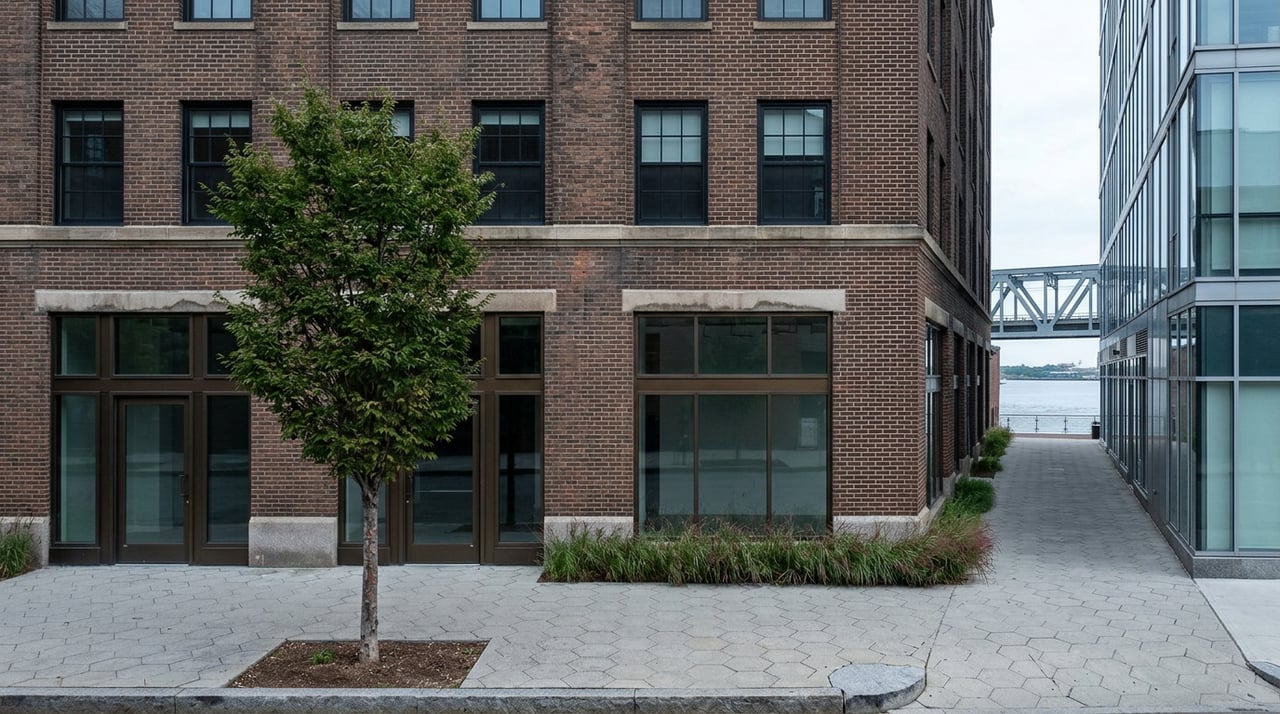
Here's the number that should reframe how you think about buying near any of this: a March 2026 report from Small Business Services and Live XYZ found an 11% ground-floor storefront vacancy rate across Mott Haven and Port Morris overall. In the 28 storefronts sitting directly around the new luxury towers, the vacancy rate was 21%, nearly double the neighborhood average.
Proximity to the new development, the thing every listing photo and every rezoning presentation treated as the obvious win, correlates with more empty storefronts, not fewer.
Angueira put it plainly when he talked about why he bet early:
"I was from the Bronx, you know, we believed in the Bronx very strongly, and we were looking for opportunities."
That belief wasn't wrong about the neighborhood. It was wrong about who would be walking through the door and what they could afford to spend once they got there.
A few blocks tell the whole pattern:
- Beatsro closed its dining room in May 2026 after nearly a decade of betting on waterfront foot traffic that never fully converted into paying customers.
- Chocobar Cortes, a well-reviewed spot built around a chocolate-infused menu, closed in late 2024 after a string of break-ins and a fight to stay open that outlasted its finances.
- Nourish, a nonprofit-owned cafe and restaurant, opened in that same former Chocobar space on August 8, 2026. It's owned by the Oyate Group, and every dollar of profit funds youth scholarships and community programs rather than an owner's return.
- La Morada, a family-run Oaxacan restaurant that predates most of the waterfront construction, has stayed open through it, building its base on the neighborhood as it already existed rather than the one developers were forecasting.
The businesses that assumed a Manhattan-adjacent clientele struggled. The one that rebuilt its model around the neighborhood's actual residents opened successfully this month.
The Math the Business Plans Skipped
More than half of households in Mott Haven and Melrose earn under $40,000 a year, per the same Bronx Times investigation. Nelly Mobley, a Bronx native who has lived at Third at Bankside for a year and a half, told the paper that some businesses overestimated how much local residents could actually afford to spend.
That's the gap in one sentence. A restaurant priced for a $4,000-a-month tenant and a restaurant priced for a $40,000-a-year household are not the same business, and a lot of the storefronts along the waterfront were built for the first customer while sitting in a neighborhood mostly made up of the second.
Tomas Ramos, who runs Nourish through the Oyate Group, described wanting to bring people the kind of night out they'd get on the Lower East Side, where you can move from a drink at one spot to dinner at another. That's an ambitious goal for a South Bronx block. It's also a goal built around what the neighborhood said it wanted, funded by a model that doesn't need to hit a market-rate rent to survive.
What the City's Own Planning Fights Show
The affordability tension isn't just showing up in restaurant math. In June 2026, Bronx Community Board 1 voted down a proposal for 537 affordable apartments at two waterfront parcels, arguing the project still wasn't affordable enough for the families already living there. Much of the objection centered on how the city calculates Area Median Income, which folds in wealthier suburban counties alongside the five boroughs and, critics say, overstates what Bronx households actually earn.
The numbers back up the frustration. The Association for Neighborhood & Housing Development's 2026 Housing Risk Map found that Community District 1's median household income equals just 23% of the official Area Median Income. When a federal benchmark is set nearly four times higher than what most local families make, "affordable" housing and restaurant pricing built to that benchmark will keep missing the people next door.
What This Means If You're Looking at Mott Haven
If you're evaluating a purchase here, the neighborhood-level headline is less useful than it looks. "Mott Haven is booming" and "this specific block near the water is booming" are different claims, and the vacancy data says you can't assume the second from the first.
A few things worth checking block by block rather than taking on faith:
Who's actually renting the ground-floor space nearby. A storefront filled by a nonprofit cafe or a long-running family restaurant is a different signal than one filled by a high-concept spot that opened eighteen months ago. Turnover speed tells you more than current occupancy.
Whether the retail concepts match the neighborhood's income, not just the new building's rent roll. A block can have full apartments and empty storefronts at the same time, and Mott Haven currently does.
Timing on nearby catalysts. The Hip Hop Museum at Bronx Point was expected to open sometime in 2026 and anchor foot traffic to the area. As of a July 2026 site tour with the museum's founder, that opening has been pushed to spring 2027. If a listing or a pitch leans on the museum as a near-term reason to buy, the math on "near-term" just moved by close to a year.
What current asking prices assume. Active for-sale listings across Mott Haven carried a median price near $1.2 million as of mid-2026. That figure sits well above what the retail vacancy data suggests the immediate area can support in day-to-day spending, which is worth keeping in mind before treating a new listing's price as proof of demand rather than a seller's opening position.
None of this means Mott Haven is a bad place to buy. Bankside Park gave residents their first waterfront access in a century. New Metro-North stations elsewhere in the East Bronx are expanding transit options across the borough, even if timelines have slipped there too. The neighborhood is absorbing real investment. It's just absorbing it unevenly, block by block, in a way that a single median price can't show you.
A Couple of Follow-Up Questions
Does being close to Bankside or Maven automatically help a mixed-use property's ground-floor value? Not on the current data. The blocks closest to the newest towers have nearly double the storefront vacancy rate of the neighborhood overall as of early 2026. Proximity to new residential density hasn't yet translated into retail demand strong enough to fill the space around it.
Is the housing side of the market still moving, even if retail is uneven? Residential absorption has continued through a mix of price concessions and income-restricted lotteries. The June 2026 fight over the 537-unit proposal shows that new affordable housing is still working its way through city review, even as the terms of what counts as affordable stay contested. The housing pipeline hasn't stalled. It's just not filling on the original luxury-rent assumptions.
Buying in a neighborhood mid-transition means the story you hear and the block you're standing on can tell you two different things. If you're weighing a purchase in Mott Haven or anywhere else in the Bronx, it helps to have someone looking at the specific block, not just the neighborhood-wide narrative. HLRE works with buyers, sellers, and investors across the Bronx and the rest of Westchester and New York City, and can walk through what a given property's numbers actually support before you make an offer. Let's Connect.